This is the fun part of public history.
/"Mr. Tesla is not doing anything to give us encouragement, and I guess as far as Tesla patent speedometer business is concerned, we are through.”
Waltham Watch Company General Manager I. E. Boucher wrote that to inventor Stead Asquith on December 3, 1928.
Boucher's frustration with Nikola Tesla over royalty payments boiled over. For over a year, Boucher tried to convince Tesla that the premiums they had to pay him (rightly, according to their licensing agreement made a decade earlier) were too high to keep their speedometers competitive.
In our new exhibition, "Nikola Tesla: The Speed of Innovation," Boucher's was one of the most prominent and colorful voices in the Charles River Museum of Industry & Innovation's archive.
Boucher and Waltham Watch President Frederic C. Dumaine took control of the company in 1923 after a major reorganization. They cut costs, weathered the "Monster Strike" of 1924, and slowly returned the operation to profitability.
And Mr. Tesla's design was not off-limits.
Before coming to Waltham, Boucher had a successful stint at the Amoskeag Manufacturing Company in Manchester, NH. He worked his way from being a "truck boy" in the Amoskeag Dye House (Print Works) in 1902 to his leadership of one of the most important manufacturing sites in the US.
I got a sense of his no-nonsense managerial leadership through his correspondence with Tesla and Asquith, though, surprisingly, images of Boucher were hard to find.
But research would yield a much more exciting lead - someone with living memory of I. E. Boucher!
Through a series of twists, we found ourselves face-to-face with Boucher's grandson here at the Museum, holding a photo album, several related items, and lots of memories. He had lived with his grandfather for the early part of his childhood. Boucher's grandson was accompanied by his wife and daughter, all three visiting our museum for the first time.
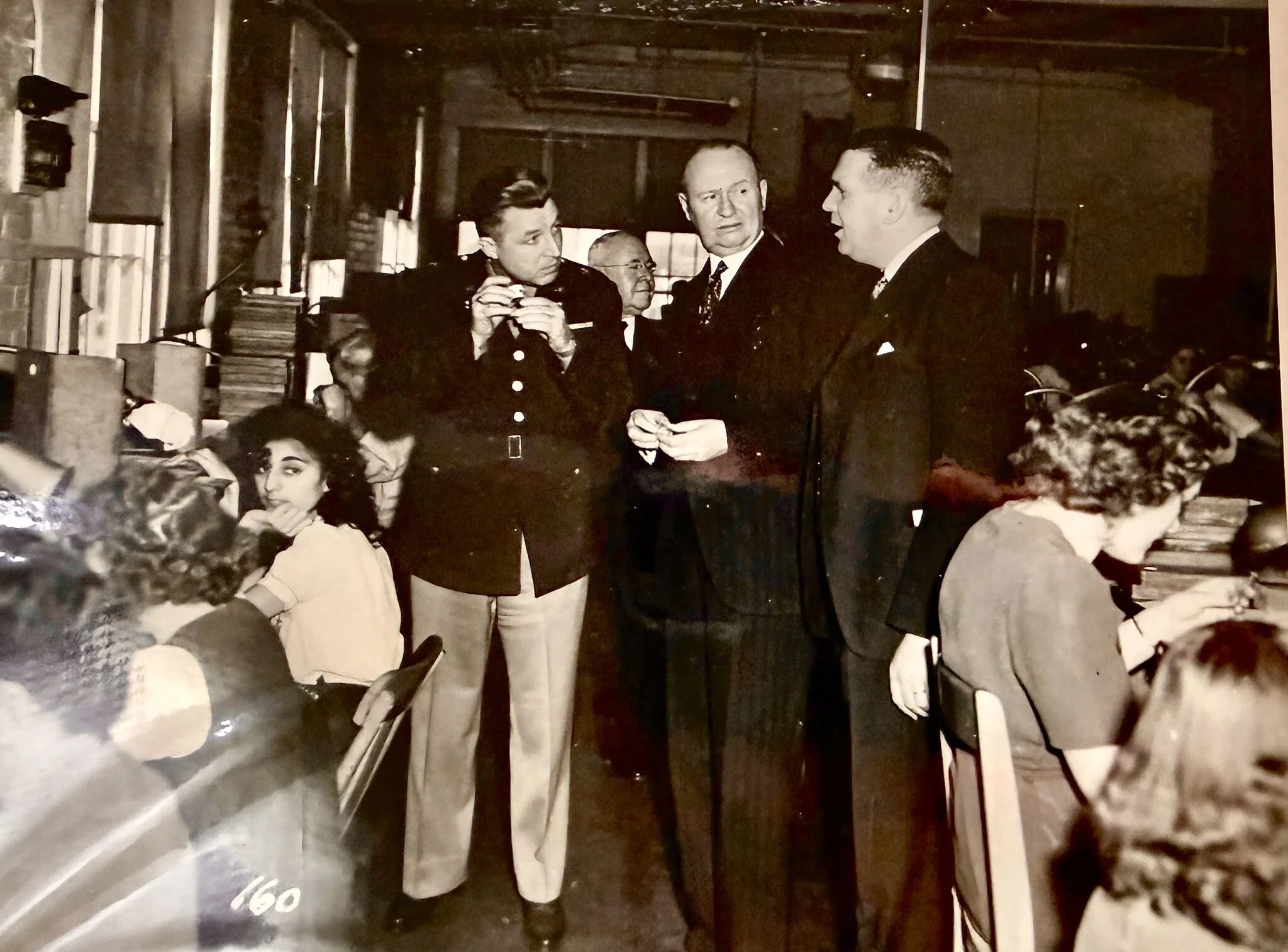
This image is one of our favorites from that album. Boucher, the taller man at center, is looking askance at a fellow executive, while a US military officer holds a small component, underscoring the importance of defense contracts that Waltham had to bolster its precision instrumentation sales.
Seeing Boucher's face, we can easily imagine him writing to Asquith on September 15, 1928:
“The situation on speedometers is growing worse with us, and it appears now it is possible we may have to give up the business entirely. Mr. Tesla has not been willing to listen to reason. He would not consider selling his patent, nor would he reduce his royalty, and we can no longer compete.”
In return, we really enjoyed sharing with Boucher's descendants the pivotal role he played in the company's relationship with Tesla.
This is the fun part of public history.
*And are you like me and want to know everything about the woman turned from her assembly line station to look straight into the camera?
Photo courtesy of Ed Simmons, grandson of I. E. Boucher