The Charles River Museum’s MA250 Project
The Charles River Museum of Industry & Innovation is showcasing Waltham’s legacy of revolutionary innovation as part of Massachusetts’ 250th celebration
These 12 public history displays were displayed around Waltham
from Fall 2025 into Summer 2026.

At left is one of those displays
It honors Michael Folsom,
founder of the Charles River Museum.
You can still visit this display on site at the Museum!
Who was Michael Folsom?
Michael Brewster Folsom was a teacher, scholar, and industrial historian who was the driving force behind the creation of the Charles River Museum of Industry and Innovation. He was active in the Society for Industrial Archeology and taught humanities, anthropology, and archaeology at MIT and later at Brandeis University. In 1975, as part of his MIT course, Culture and Society in America: The Rise of a Technological Civilization, Mike brought students out to the Francis Cabot Lowell mill site in Waltham next to the Moody Street dam. At the time, the mill complex was mostly abandoned and considered an eyesore.
Yet Folsom knew the mill’s pivotal role in launching the American Industrial Revolution
The 1814 Boston Manufacturing Company (BMC) textile mill was the first fully integrated factory in the world. Here, for the first time, bales of raw cotton were picked and cleaned, the fibers were drawn out and spun, the yarn was woven into cloth, and the fabric was bleached and dyed to produce bolts of finished cloth. The BMC was the first factory to turn raw goods into market-ready products in a singular location, under a single power source, and with a dedicated workforce.
Folsom knew that this space needed to be preserved. He was instrumental in the site being declared a National Historic Landmark District, granting it federal protection and an opportunity to renovate the mill into senior housing, and the old Boiler House and Engine Room into a new museum. Thus, in 1988, with the help of Waltham’s community and industrial historians all over New England, the Charles River Museum opened its doors to the public. As the first Executive Director, he was incredibly forward thinking. Recently unearthed papers of his demonstrate his commitment to education, environmentalism, racial justice, workers rights, and the local community.
Who was Paul Moody?
Paul Moody perfected the power loom which allowed the Boston Manufacturing Company to become the first fully integrated factory in the world. Moody grew up in Newbury, MA in the late 1700s with ten siblings. His father owned farmland and a gristmill site where grain was ground into flour.
In his youth, Moody quickly realized that he had an aptitude for mechanics. He left preparatory school after only a year of attendance. By his early teens, he had declared independence from his family and supported himself by working at a local wool mill where he learned the fundamentals of weaving. He then went from working at Jacob Perkins’ nail factory to forming the Amesbury Wool and Cotton Manufacturing Company. It was here that he acquired the skills essential for building and maintaining factory machinery.
In the early 19th Century, Francis Cabot Lowell and the Boston Associates were looking to build textile mills in the United States as a way to gain economic independence from the British. To do so, they had to first learn how the thriving mills of England were using waterpower to create machine-produced textiles. In 1812, Lowell visited power mills in England and memorized exactly how their machinery worked so he could not only replicate but improve upon their designs. After returning, Lowell and Patrick Tracy Jackson attempted to build a machine crucial to their success, a powerloom. Nonetheless, they quickly realized that the construction of this machine was beyond their skill set. They contacted Jacob Perkins, as he was the best-known mechanic in the area at the time. Perkins was occupied with other projects and recommended that the Boston Associates reach out to Paul Moody instead. Moody successfully built a power loom akin to this one here and soon made himself indispensable to Francis Cabot Lowell and the BMC.
Moody went on to build the Lowell Machine Works, serve as the chief engineer for the Proprietors of Locks and Canals company, and start a large machine shop where his innovations earned him multiple patents. Moody was also a leader in his community. As his wealth increased, so did his role in Lowell and the surrounding area. He was an advocate for the alcohol temperance movement and a frequent churchgoer. He was married to Susan Morrill and the father of three sons. He died in 1831 and has been honored by having several streets named after him including Moody St in Waltham.
Who was Charles Metz?
Charles Metz produced innovative bikes, automobiles, and motorcycles right here in Waltham. Born in 1863 in Utica, NY, Metz’s path to innovation began with his father, a mechanic whom he apprenticed under. Metz would later be employed by Orient Fire Insurance Company. Although he only worked there for a few years, his time there would serve as the namesake for the line of “Orient” bicycles that his company became well known for.
Metz was a talented bicyclist, racer, and mechanic; thus, it didn’t take long for him to find his place within the bicycle industry. As early as 1883, he was working as an agent for Columbia Cycles in his hometown of Utica, New York. He then moved to the Boston area to design bikes for the Union Cycle Club in Newton. In 1893 he opened the Waltham Manufacturing Company with three partners. His love for racing inspired Metz to design lightweight, high performance bikes that were used by celebrity athletes and casual cyclists alike across the country.
The Waltham Manufacturing Company was notable for its production of popular bicycles, tandem bikes, the first motorcycles, and cars. Listed in catalogs for the first time in 1899, the Orient-Aster was an Orient Bicycle with a French-built engine. Advertisements and literature referring to the Orient-Aster are the earliest published uses of the word “motorcycle.” The official public debut of the Orient-Aster was on July 31st, 1900 at the Charles River Race Park in Boston during the first officially recorded motorcycle speed contest in the United States. Metz’ Orient won.
Charles Metz stepped away from Waltham Manufacturing Company until 1907 when the president of Waltham National Bank wrote to him asking if he would once again take charge of the organization. The company had been producing cars but was not finding much success. Metz turned their profits around with The Metz Plan Car. This consisted of 14 sets of packaged parts through which individuals could build their very own cars. At only $25 per set, The Metz Plan Car was roughly $150 cheaper than the average price for an automobile.
The Waltham Manufacturing Company sold 500 of these before focusing on the sale of fully-assembled cars once again in 1909. The last Metz vehicle was produced in 1923. Charles Metz drove this car to Glendale, CA where he and his family lived until he passed away in 1937.
Metz was awarded over 20 patents in his lifetime. He had many other notable innovations such as the 1896 Ori-ten which seated up to ten riders. Additionally, in 1898, Metz made one of the first electric cars for the General Electric Company in Lynn.

Who were the Apollo 11 Weavers?
The innovation and hard work of 534 women played a vital role in landing the first humans on the moon. The phrase “Apollo 11 Weavers” specifically refers to a group of women who helped build the Guidance Computer (AGC) that directed Apollo 11 to its galactic destination and back.
The AGC was very advanced for the time. So much so that the technology needed to automate the manufacturing of its memory had not yet been invented. Thus, its core rope memory had to be woven by hand alongside fitting the lightness, compactness, and indestructibility requirements set by NASA. This project was based out of the MIT Instrumentation Lab in the 60s. They collaborated with subcontractors such as Waltham-based Raytheon which was responsible for producing the final product that would be brought to space.
Raytheon needed skilled workers to create this hardware and knew just where to look, former employees of the Waltham Watch Company and experienced weavers who worked in textile mills. Some of these women may have come from the Boston Manufacturing Company as their status as elders is frequently referenced in a 2001 interview with a series of men who worked at Raytheon in the late 50s and early 60s. They were specifically called “little old ladies.”
These women created computer software by weaving half a mile of Nickel alloy wire through 512 magnetic cores. This was based off of the punch cards derived from sheets of code. One participant reflects on working with them in the aforementioned interview stating that, “we paid those women to sit there and wait until the deck of cards or the tape came out. And they would be sitting there knitting for two or three weeks. And then the deck of cards would come out, or the program would come out, and they’d go like hell.”
In November of 1966, there was a strike of over 10,000 Raytheon workers after negotiations with the union went south. During this walk out, the supervisors and managers tried to complete the work that the women had been doing. When the strike ended, their work was assessed and all of it had to be scrapped. One worker in the interview recalls how this moment taught them that, “you'd think you could just-- but you couldn't, you needed those girls-- little old ladies-- who wound those ropes.” Their labor was far more complex than management gave them credit for.”
The women successfully wove the entire core memory for Apollo 11. Thanks to their innovation, Neil Armstrong and Buzz Aldrin made it to the moon and back. An ongoing project at MIT called Sisters in the Making is looking to uncover more information about these innovators and their lives before, during, and after this period. Much of the information about this historic legacy has come from their virtual archive.
Who was Marshal Walter “Major” Taylor?
In the 1890s the United States had a “bicycle craze” during which bicycle racing, production, sales, and general enthusiasm rapidly increased. Major Taylor was a famous cyclist who made waves during this craze using Waltham-made bikes. Marshall Walter “Major” Taylor was born in Indianapolis in 1878. His family moved to Chicago in 1890. In 1891, he found work at a local bike shop where he performed “homemade tricks” in front of the shop in an officer’s uniform, earning the nickname “Major”
In 1893 he was forced to participate in a 10-mile amateur bike race hosted by his bike shop against his will. He won the race and was noticed by popular racing legend Birdie Munger who got him involved in the racing scene.
In 1895 he relocated to the Boston area where there were more opportunities for Black cyclists. He quickly developed a reputation as one of the fastest racers in the country. In 1897, he began exclusively riding Orient Bicycles which were made by the Waltham Manufacturing Company. While racing for this company, Major Taylor reached the peak of his bicycling career. Between 1898 and 1899 he established seven world records and was known as the fastest sprinter if not the fastest rider in the United States.
Who was Francis Cabot Lowell?
The Embargo Act of 1807 limited the United State’s access to the fine cotton fabrics they had been getting from England. Francis Cabott Lowell, a merchant with unique access to wealth and resources due to his connections to both the Cabott and Lowell families, saw this as an opportunity to gain economic independence from England by advancing the American textile industry.
Using his connections as a merchant, Lowell visited powermills in England in 1812 to learn how the British were using waterpower to mass-produce textiles. On the ship back to the U.S. his luggage was searched to ensure that he had not taken any notes on their trade secrets. Little did the British know that Lowell had memorized how their machinery worked and by 1813 had reproduced and improved upon their designs to create The Boston Manufacturing Company, the first fully integrated factory in the world. Here, he utilized a temporary workforce of mainly young women that received benefits such as housing, and education alongside their wages to turn raw goods into market-ready goods under one roof
Just four years later, he died unexpectedly. Nonetheless, his efforts mark the real beginning of the American Industrial Revolution and his model of production, labor, and management spread like wildfire throughout the country. Today, this is known as the “Waltham-Lowell System” to signify Lowell’s creation of it and its beginning in Waltham.
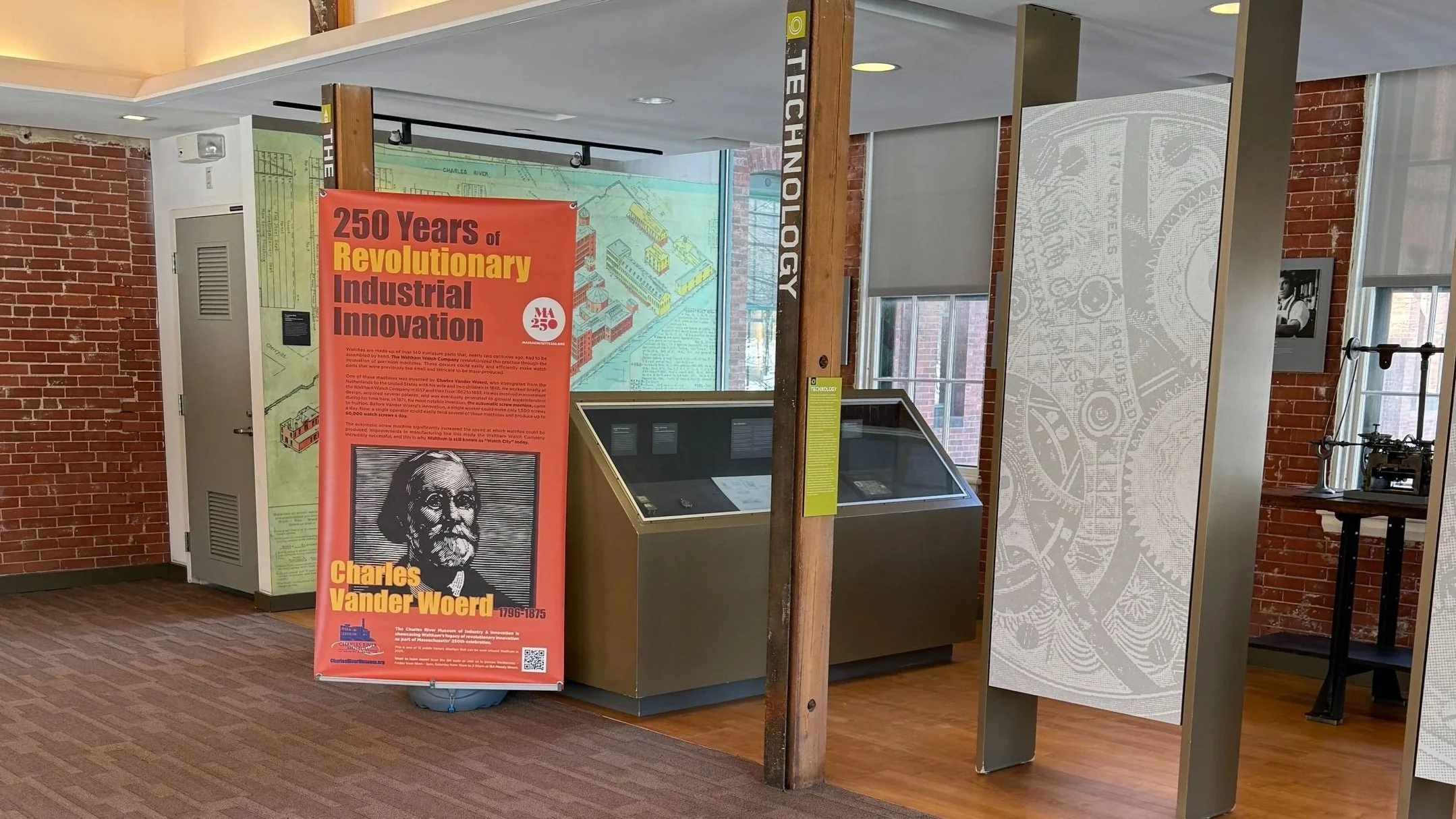
Who was Charles Vander Woerd?
Watches are made up of 140 miniature parts that, historically, had to be assembled by hand. The Waltham Watch Company revolutionized this practice through the innovation of precision machines. These devices could easily and efficiently make watch parts that were previously too small and intricate to be mass-produced.
One of these machines was invented by Charles Vander Woerd, who immigrated from the Netherlands to the United States with his wife and two children in 1846. He worked at the Waltham Watch Company briefly in 1857 and then from 1862 to 1883. HE was involved in movement design, acquired several patents, and was eventually promoted to general superintendent during his time here. In 1871, his most notable invention, the automatic screw machine, came to fruition. A single operator could easily tend several of these machines and produce up to 60,000 watch screws a day. Before Vander Woerd’s innovation, a single worker could make only 1,500 screws a day.
The automatic screw machine greatly increased the speed at which watches could be produced. Improvements in manufacturing like this made the Waltham Watch Company incredibly successful, and this is why Waltham is still known as “Watch City” today.
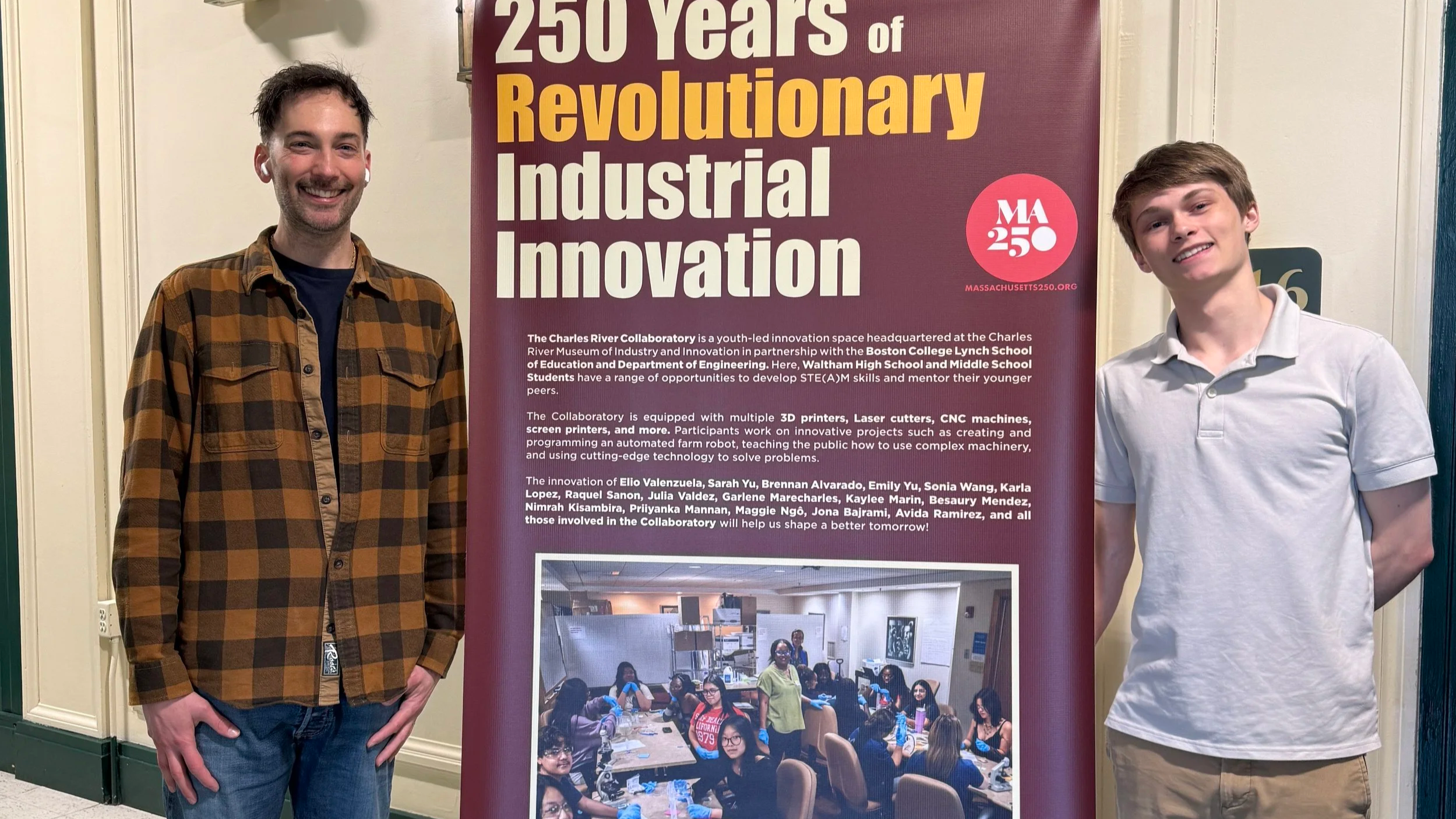
Who are the Students and Leaders of the Charles River Collaboratory?
The Charles River Collaboratory is a youth-led innovation space headquartered at the Charles River Museum of Industry and Innovation in partnership with the Boston College Lynch School of Education and Department of Engineering. Here, Waltham High School and Middle School Students have a range of opportunities to develop a multitude of STEAM skills and mentor their younger peers.
The Collaboratory is equipped with ten 3D printers, Laser cutters, CNC machines, screen printers and more. Participants work on innovative projects such as creating and programming an automated farm robot, teaching the public how to use complex machinery, and using cutting edge technology to solve problems.
The innovation of Elio Valenzuela, Sarah Yu, Brennan Alvarado, Emily Yu, Sonia Wang, Karla Lopez, Raquel Sanon, Julia Valdez, Garlene Marecharles, Kaylee Marin, Besaury Mendez, Nimrah Kisambira, Priiyanka Mannan, Maggie Ngô, Jona Bajrami, Avida Ramirez, and all those involved in the collaboratory will help us shape a better tomorrow!
Who is Jodi Rosenbaum?
Jodi Rosenbaum is the founder and CEO of More Than Words (MTW), a nonprofit social enterprise that empowers youth who are court-involved, in foster care, out-of-school, and/or experiencing homelessness to take charge of their lives by taking charge of a business.
The organization began in 2004 as a used bookstore on Moody Street in Waltham run by youth who could use the space to not only build valuable job skills but also as a vehicle to plan for their critical transition to adulthood. That Waltham store and online book warehouse moved to 56 Felton Street in 2016 and is a vital part of the Waltham community.
MTW now has three retail stores and has grown both their retail offerings and support services to include youth development programming, long-term career services, court advocacy, housing support, healthcare, and more. Today, MTW serves over 300 young people annually in a whole-person model that empowers youth to successfully transition to adulthood and thrive in a self-sustaining career.
Who was Isaac Ebenezer Markham?
Isaac Ebenezer Markham was born in Middlebury, Vermont in 1795. At the age of 17, he began working for David Page Jr, who established some of the earliest cotton mills in his home state. Here, Markham gained a deep understanding of machinery that landed him a position in 1820 at the Boston Manufacturing Company (BMC).
May 30th, 1821 he sent a letter to his brother from Waltham that is vital to our understanding of local and national industrial history. In it he writes that when faced with unexpected wage cuts, the women working at the May 30th, 1821 “as one revolted & the work stopped for 2 days.” Today, this serves as the only known record of the Boston Manufacturing Company’s 1821 strike, the first industrialized labor strike in the history of the United States.
Markham ended up leaving the BMC on December 1st, 1821 and returned to Middlebury. He rejoined David Page’s factory where he became the superintendent and agent for the organization. He worked here until he passed in 1825 and was celebrated for his “noble and generous feelings” alongside his “mind of singular felicity of invention, originality, and strength.”
Who was Katherine (Kittie) Knox?
Katherine (Kittie) Knox was born in Cambridge in 1874 to a Black man from Philadelphia who worked as a tailor and a white woman who worked in the textile mills in Biddeford, Maine. She was a pivotal figure in the northeast’s biking scene and was the first Black person to be accepted into the League of American Wheelman (LAW).
In 1895 Kittie Knox won first place at the LAW’s meeting at Waltham’s velodrome. This local raceway was one of the fastest cycling tracks in the country. Though she was celebrated for her speed, Kittie’s victory was in the “costume contest” category. During this time, women were expected to wear skirts and ride “step-through frame” bicycles that could accommodate their dresses. Knox had no interest in these slower bike frames and defied gender norms by fashioning her own outfits that allowed her to ride men’s bikes. These ensembles often consisted of baggy trousers, short coats, and tight leggings.
Kittie Knox’s story and her importance to our local history was only recently rediscovered by local historian Lorenz J. Finision. Today Kittie’s gravesite can be visited at Mount Auburn Cemetery where it is marked with a headstone displaying a bicycle.
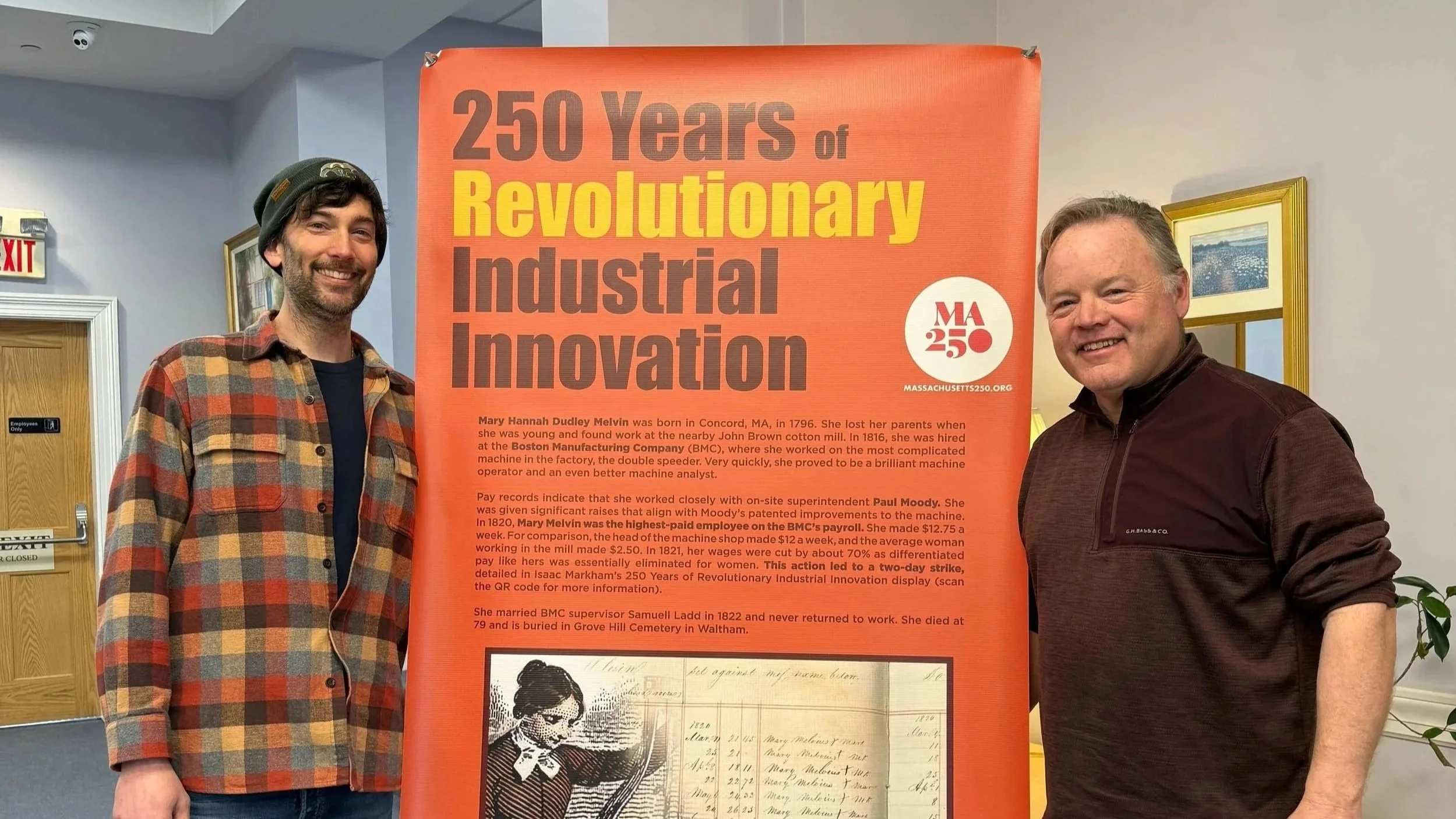
Who was Mary Melvin?
Mary Hannah Dudley Melvin was born in Concord, MA in 1796. She lost her parents when she was young and found work at the John Brown cotton mill nearby. In 1816, she was hired at the Boston Manufacturing Company (BMC) working on the most complicated machine in the factory, the double speeder. Very quickly, she proved to be a brilliant machine operator and an even better machine analyst.
Pay records indicate that she worked closely with on-site superintendent Paul Moody. She was given significant raises that align with patented improvements to the machine submitted by Moody. In 1820, Mary Melvin was the highest paid employee on the BMC’s payroll. She made $12.75 a week. For comparison, the head of the machine shop made $12 a week and the average woman working in the mill made $2.50. In 1821 her wages were cut by about 70% as differentiated pay like hers was essentially eliminated for women. This led to a two day strike that can be learned about in Isaac Markham’s industrial innovation display.
She married BMC supervisor Samuell Ladd in 1822 and never returned to work. She died at the age of 79 and is buried in Grove Hill Cemetery in Waltham.