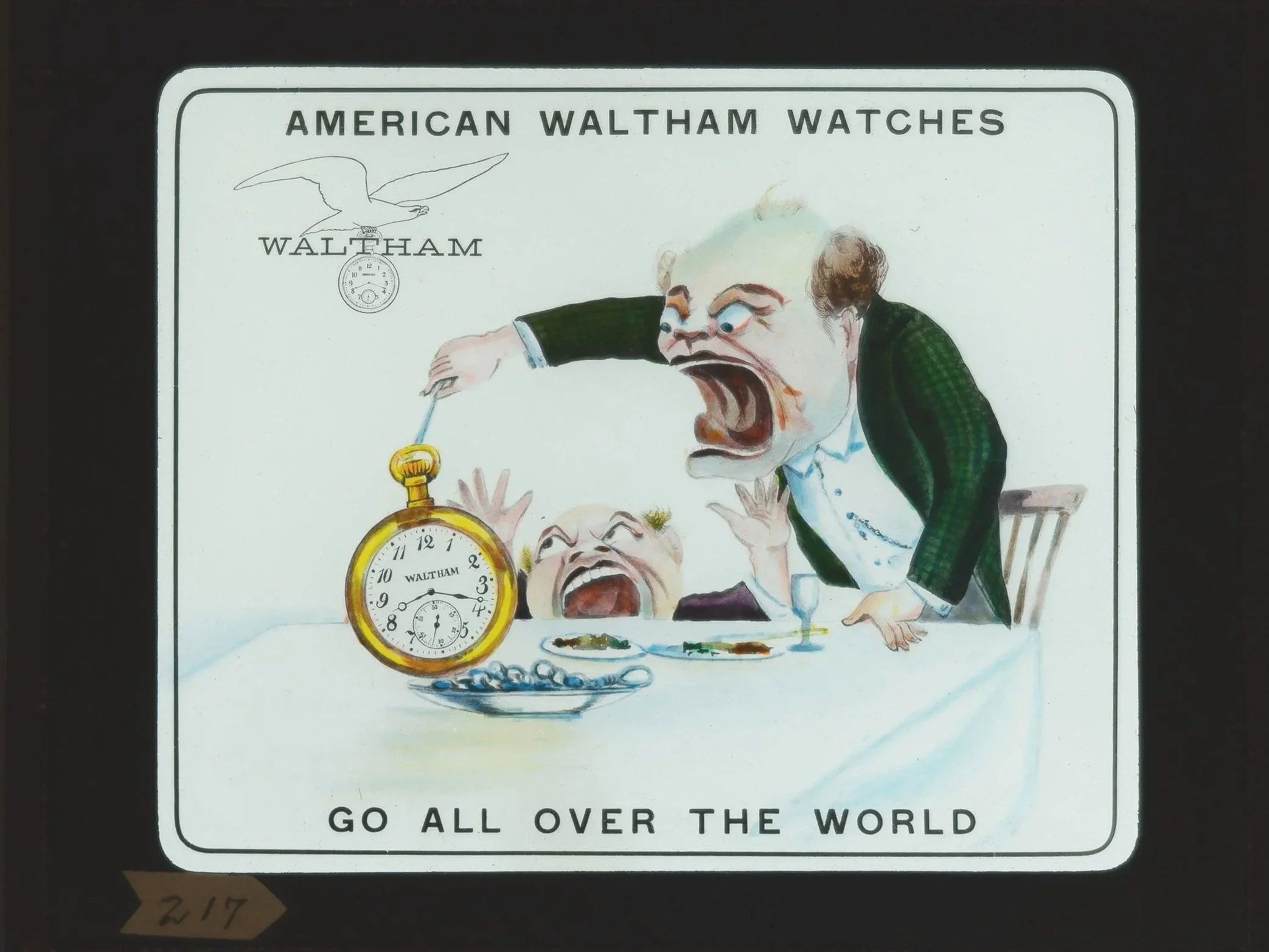
"American Waltham Watches Go All Over The World"
/Within our Waltham Watch Company collection is a family of 140+ beautiful, hand painted glass positives showing Waltham Watch Company advertising imagery, circa 1900-1910.
American pocket watches were among the first consumer goods sold in Japan after the Meiji Restoration, and Waltham Watch was at the vanguard. For several decades of the 19th century, Waltham dominated the market for precision machining and mass-produced a huge array of watches and clocks, including items for international markets.
In our storage area, we've been sorting a box of several dozen glass positives from the "American Waltham Watches Go All Over The World" campaign, which features wild and weird images of anthropomorphic watches and clocks in scenes we can't even begin to explain.
Many of them feature Asian, specifically Japanese, motifs.
There's a strong "Alice in Wonderland" vibe to most of them, and of course, a number of problematic depictions of foreign figures.
One of the slides had a substantial amount of writing, as well as the Waltham Watch eagle. Here's what we've found out about it.
The translation:
“The Waltham watch you own is clearly and certainly stamped on the back of the watch with the words ‘The Best.’ Behind this guarantee, which is assured in perpetuity, stands the world’s largest factory, making the finest of timepieces: the American Waltham watch.”
A couple of notes on the period flavor: the text uses pre-war orthography (確實 for 確実, 國 for 国, the old katakana ヰ-era conventions), consistent with a circa 1900 to 1910s dating. “貴下” (kika) is a formal second-person address, roughly “your esteemed self.” The watch face in the image reads "WALTHAM" and features a classic small-seconds subdial at 6.
Pocket watches became iconic markers of the Westernization movement, in tandem with industrialization throughout the 19th and early 20th centuries. According to Hoshimi Uchida's article, “The Spread of Timepieces in the Meiji Period,” in Japan Review, no. 14 (2002):
"Around the beginning of the twentieth century, when imported timepieces still held most of the market, it was commonly said that 'high-range watches are gold, middle-range watches are silver, and 100 percent-nickel mechanisms are not so far off. But nickel is not so expensive—maybe two yen. So it’s not the mechanism or the appearance, but wearing a watch worth ten yen or more that will be the real value people will get from their watches.” Domestic pocket watches first aimed for the general public, and then aimed higher with gold and silver versions of their “Excellent,” an imitation of the U.S. Waltham watches, thereby succeeding in increasing their sales.
There is no doubt that this kind of inexpensive pocket watch increased the size of the domestic market, just as grandfather clocks had. Behind the spread of timepieces as the first Western consumer durable in Meiji period Japan was the entrepreneurship of Japanese makers aiming at taking the place of imported timepieces in the market."
And,
"Even people without watches began paying closer attention to the time, using public clocks. Spread of timepieces, the first Western consumer durable, gradually changed the sensibility of the average Japanese with respect to time over the course of the Meiji period. What made possible such changes in the social system were the supply of the hardware, at first imported and then domestically produced, and the formation of a market."