The Machines That Never Stop
/
It never ceases to amaze us how much history informs our present moment, and yet so few are aware of it. Consider how Big Tech bosses speak in almost religious or romantic terms about the AI technology they're building. It can be strange or jarring, but it's definitely not new.
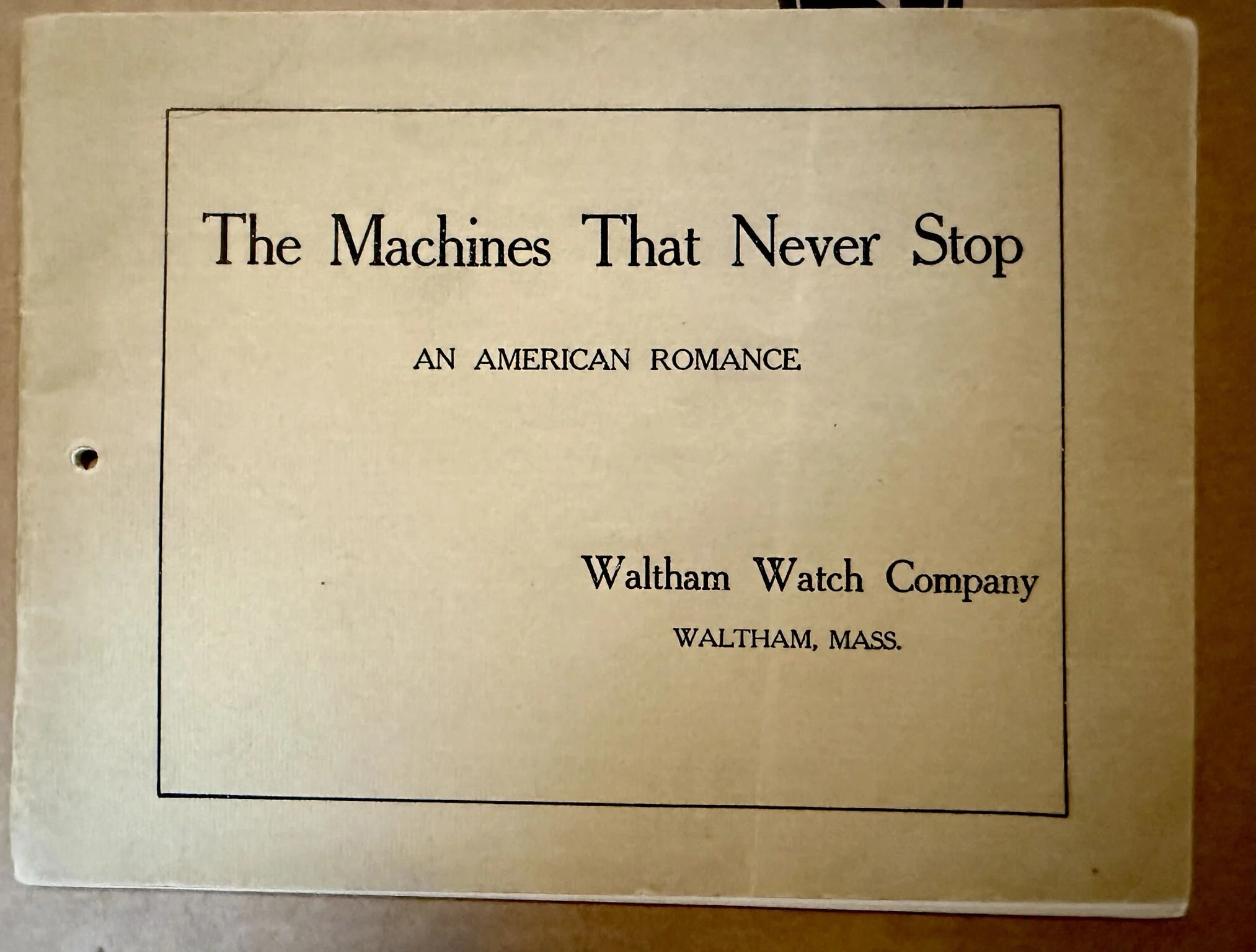
Last week, while digging through the Museum archives, our Director of Education, Steve Guerriero, pulled out this gem of a booklet, and it is a great example of what we mean. Published in the first decade of the 20th century, this marked a high-water mark of the Waltham Watch Company, the first in the world to perfect precision machining at a factory scale. Abraham Lincoln, Teddy Roosevelt, and John Jacob Astor were all owners of pocket watches made at Waltham's plant.
In 1896, an engineer named E.A. Marsh published his own account of the innovative machines developed and deployed at the Waltham Watch factory, particularly in the 1890s. Titled "Watches by Automatic Machinery at Waltham," the book was an indicator of a kind of self-awareness that those working with this new technology were doing something really important. The machines took what had been a jeweler's handicraft and made it something that could be done by increasingly complex machines, using interchangeable parts and assembly lines of specialized workers.
But this 1907 pamphlet by J. Hopkins of Waltham Watch is next level.
The title evokes some of the discourse heard now around AI: "The Machines That Never Stop: An American Romance."
A combination of both celebratory innovation bordering on hyperbole and a sense of inevitability and unstoppable progress.
But it's the preface of the booklet that really goes off:
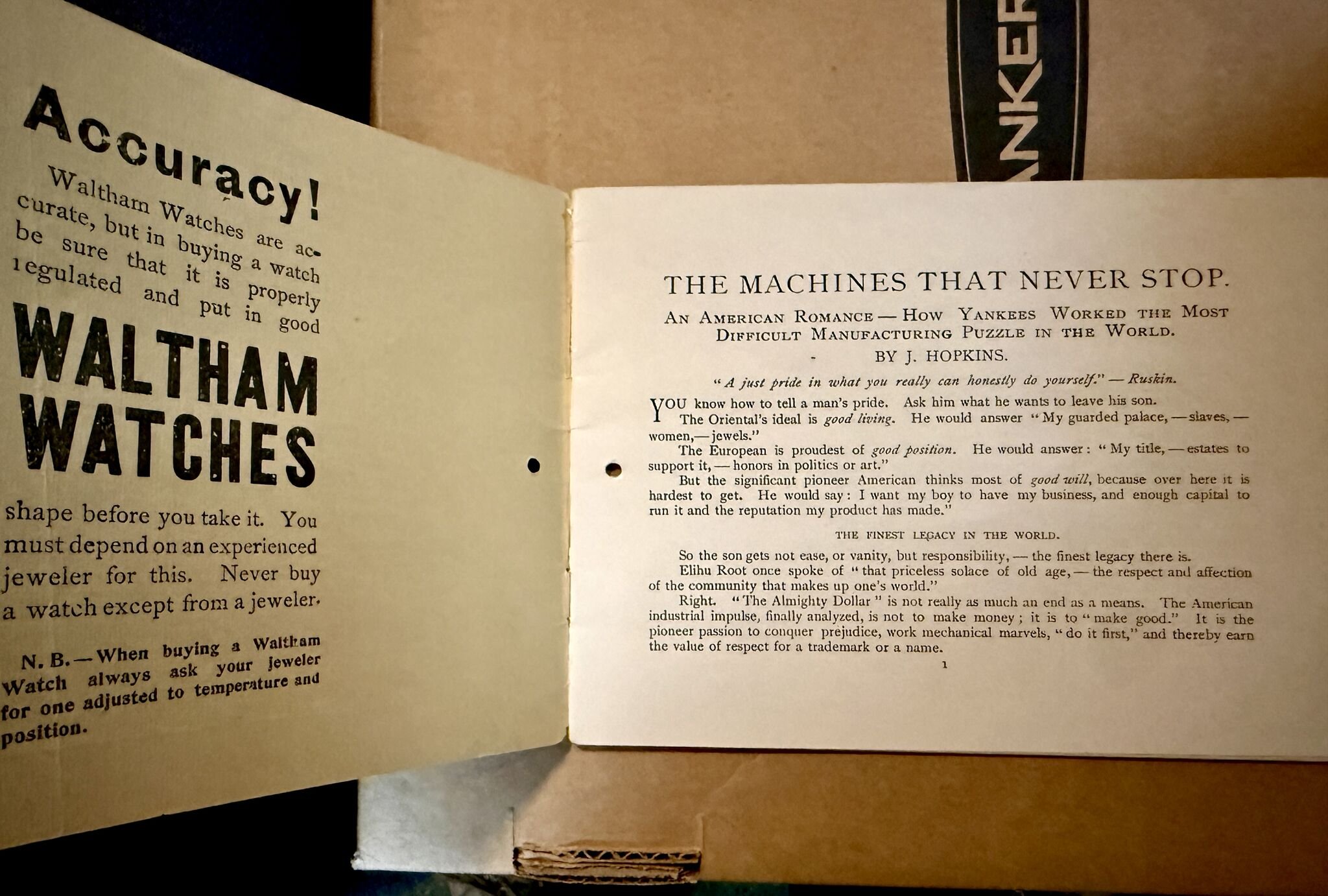
THE MACHINES THAT NEVER STOP: An American Romance--How Yankees Worked The Most Difficult Manufacturing Puzzle In The World
'A just pride in what you really can honestly do yourself.' -Ruskin
"You know how to tell a man's pride. Ask him what he wants to leave his son.
The Oriental's idea is a good living. He would answer: 'My guarded palace, slaves, women, jewels.'
”The European is proudest of good position. He would answer: 'My title, estates to support it, honors in politics or art.'
”But the significant pioneer American thinks most of good will, because over here it is hardest to get. He would say: 'I want my boy to have my business, and enough to run it and the reputation my product has made.'
”THE FINEST LEGACY IN THE WORLD
”So the sun gets not ease, or vanity, but responsibility, the finest legacy there is.
”Elihu Root once spoke of 'that priceless solace of old age, the respect and affection of the community that makes up one's world.'
”Right. 'The Almighty Dollar' is not really as much an end as a means. The American industrial impulse, finally analyzed, is not to make money; it is to 'make good.' it is the pioneer passion to conquer prejudice, work, mechanical marvels, 'do it first,' and thereby earn the value of respect for a trademark or a name."
A lot to think about.