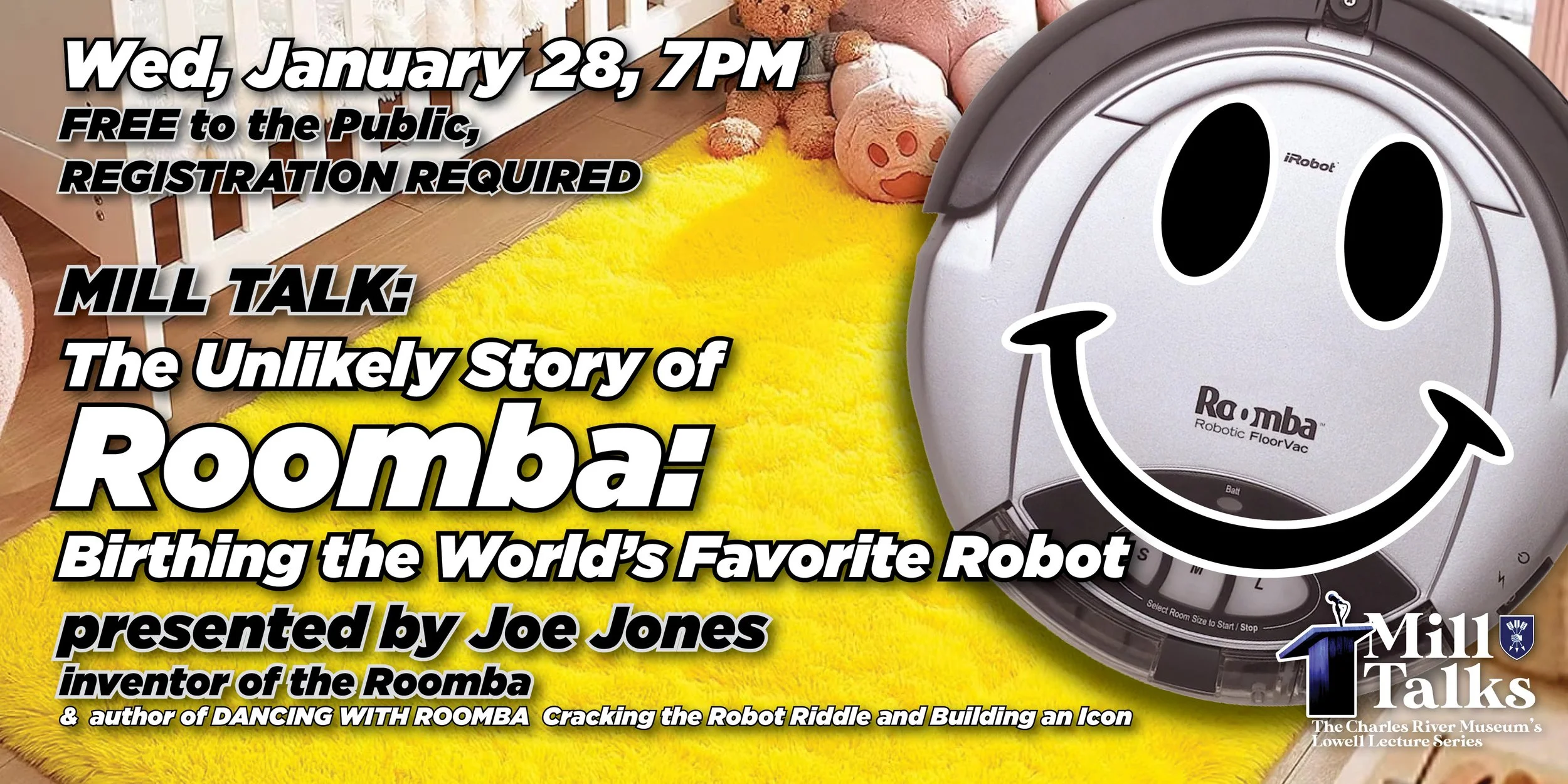
Mill Talk: The Unlikely Story of Roomba: Birthing the World’s Favorite Robot
presented by Joe Jones, inventor of the Roomba
author of DANCING WITH ROOMBA Cracking the Robot Riddle and Building an Icon
Free to the Public
REGISTRATION REQUIRED
Inventions are born amid passion and pathos. And every product has a story, but one of the most improbable is the tale of Roomba. For 40+ years major corporations and basement tinkerers alike struggled to solve the seemingly simple problem of building a robotic floor cleaner. Nothing worked. Finally, in 2002 a quirky team from an unknown company cracked the riddle and delivered Roomba. A million memes followed.
The talk recounts Roomba’s decade-long journey from a 1989 maker event at MIT to living rooms around the world.

Speaker Bio:
Born and raised in a tiny, rural Ozarks community, Joe Jones nurtured an early passion for science and technology. Encouraged by a thoughtful high school teacher, he attended MIT and spent his undergraduate days preparing for a career in experimental physics. But no compelling physics niche presented itself so, he embarked on a solo trip around the world. Returning a year later, he gained a position on the research staff at the MIT AI Lab. There he discovered his true calling: robots.
Inspired by a new paradigm in robot programming developed at the Lab, he built Rug Warrior—Roomba’s earliest direct ancestor—for a maker event. Upon leaving the AI Lab, Joe joined fledgling iRobot as the company’s first full time hire. Several years later, he and a colleague proposed Roomba. A tight-knit team formed to developed the robot and in three years they accomplished the goal that had eluded all others for a half-century.
Joe subsequently founded two companies: Harvest Automation, a maker of an agricultural robot, and Tertill Corporation, builders of a solar-powered robot that weeds home gardens. The holder of 80+ US patents, Dancing with Roomba is Joe’s fourth book.
Mill Talks at the Charles River Museum of Industry and Innovation are free and open to the public and are made possible by the generous support of the Lowell Institute.